
Keep the Seat Warm
2016–2017 · video, sound and found-object installation

Exhibition at Kuldīga Art House (Kuldīgas Mākslas nams), 2017
Keep the Seat Warm is a video and sound installation about repetition, waiting and distorted time within bureaucratic work.
The installation reconstructs an ordinary government worker's desk. On the screen, fragments of politicians' hands appear and disappear across nine fields: writing, gesturing, holding papers, checking phones. Their movements gradually become faster and more fragmented, while a ticking clock in the soundtrack begins to slow and fall out of rhythm.
Layered recordings of political speech have been multiplied until individual voices become indistinguishable from one another. As activity increases on screen while time seems to slow down, the installation moves from routine towards unease—a loop of presence, repetition and waiting in which something is constantly happening, yet very little appears to change.
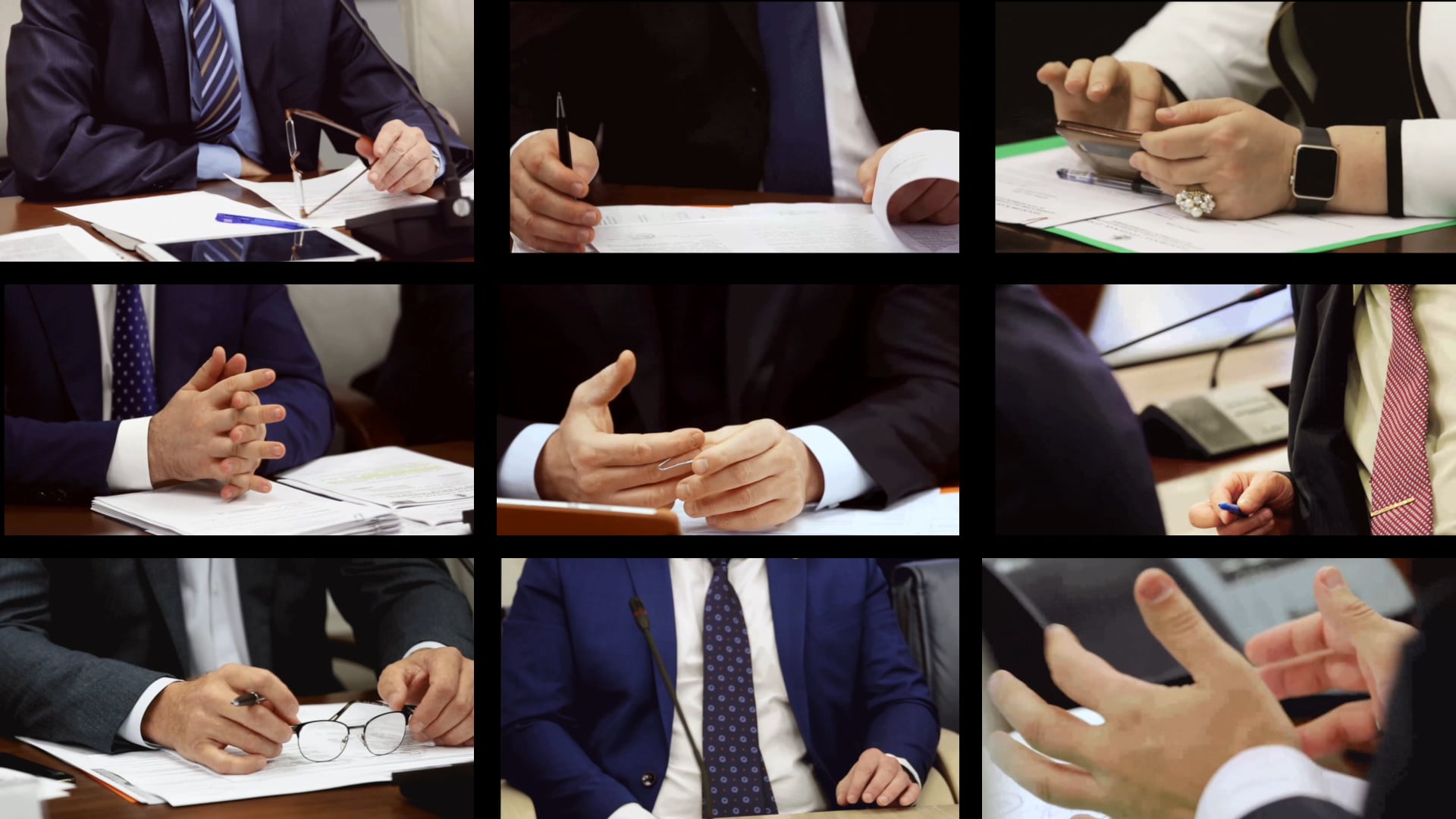
The work developed from time I spent photographing and working around government institutions. I repeatedly found myself in similar rooms, watching the same gestures, procedures and conversations unfold. People were present because they were supposed to be present; I was there for much the same reason. After a while, repetition produced a strange perceptual dullness. Days became difficult to distinguish from one another. Keep the Seat Warm translates that experience into an installation built around a desk, chair, clock, computer monitor and other familiar elements of an administrative workplace. The video begins with a first-person text appearing on screen as if it is being typed by an anonymous government employee. It is followed by nine fields containing short loops of politicians' hands. At first only a few appear. Gradually the gestures accumulate, disappear and return with increasing speed and irregularity. The soundtrack follows a different temporal logic. Recordings taken from the original video fragments are layered until speech loses intelligibility and becomes a continuous polyphonic noise. A clock initially keeps regular time above it, but gradually slows and slips out of rhythm as the visual activity intensifies. Rather than representing a particular institution or political system, I was interested in the sensation produced by repetitive structures: the requirement to remain present, the alternation between activity and waiting, and the point at which routine stops registering as individual events. The more the screen appears to do, the less stable time becomes.